
Most artists lose more sleep over three numbers than over the song itself. Is 24-bit better than 16? Should you record at 96 kHz? Do streaming platforms punish you if you are not at exactly -14 LUFS?
Two of those three "rules" are not rules at all. Here is what actually happens to your audio — and the handful of settings worth remembering before your next upload.
Myth 1: "Higher the bitrate means the better it sounds"
Bit depth does not sharpen your mix. It sets how far down quiet detail can go before it disappears into digital noise. A 16-bit file cuts off below roughly -96 dBFS; 24-bit goes down to about -144 dBFS. That is the whole difference — a lower noise floor, so you have more room to record quietly and still have clean signal to work with.
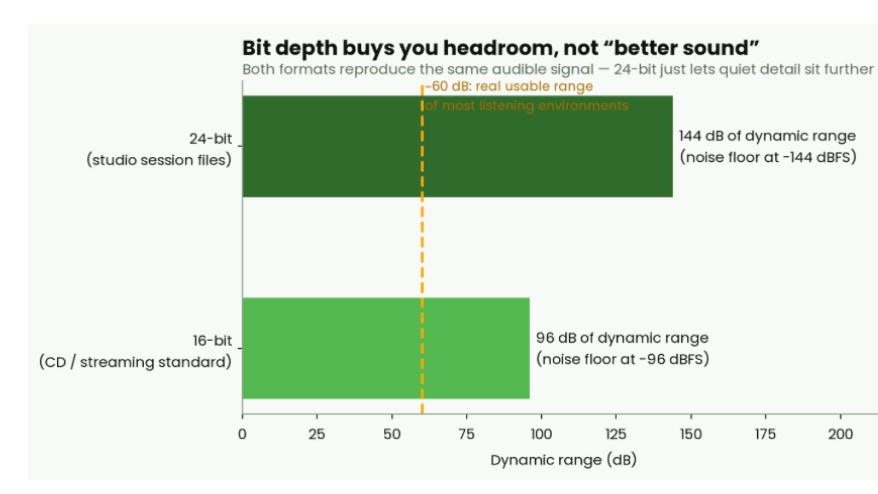
Against reality, that extra range barely exists. A busy room in Lagos or Accra has a noise floor far higher than -96 dB, and earbuds on a bus or a phone speaker at a house party cannot reproduce the bottom 40 dB of a 16-bit file, let alone a 24-bit one.
What to do: record and mix in 24-bit — the headroom protects you from clipping and bad gain-staging. Deliver at whatever spec your platform asks for. If 16-bit sounds right, it is right.
Myth 2: "Record at 96 kHz — or 192 kHz if you're serious"
Sample rate is how many moments per second you capture, and a file can only reproduce frequencies up to half its rate. So 44.1 kHz reaches 22.05 kHz and 192 kHz reaches 96 kHz — but human hearing tops out around 20 kHz, well below for most adults.
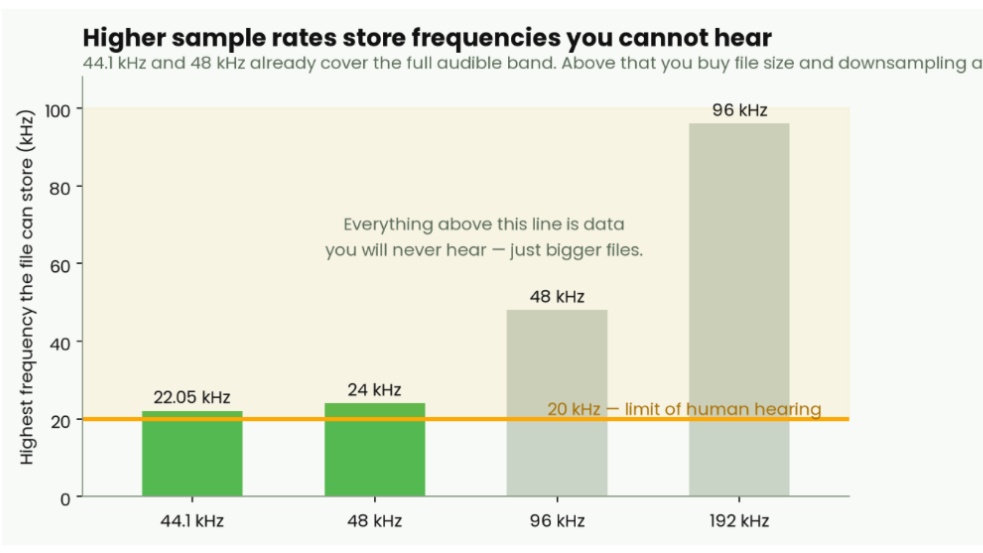
Everything above that orange line is data nobody will hear. The costs are real, though: a 192 kHz session is over four times the file size, eats CPU so you get fewer plugins before your laptop chokes, and has to be downsampled for release anyway — and every conversion is a chance to add artefacts.
One legitimate use exists: mastering engineers oversample internally to catch inter-sample peaks and keep limiters clean. That happens inside the processing chain — it is not a reason to track vocals at 192 kHz.
What to do: stay at 44.1 kHz, or 48 kHz if the song may end up in video. Match the rate you recorded at instead of converting mid-project.
Myth 3: "Master to -14 LUFS or Spotify will turn you down"
This is the one that does real damage, because it makes artists squash good mixes to hit a number.
What is actually true: platforms normalise playback so listeners are not reaching for the volume between songs. That is a playback setting, not a submission requirement. A loud master is not "punished" — worst case it ends up as loud as everything else, only with flatter dynamics because you compressed the life out of it to get there.
The myth comes from confusing two measurements. Short-term LUFS tells you how loud a section feels right now — that is what you judge your chorus by. Integrated LUFS averages the whole track, so it moves with your arrangement, not with your impact.
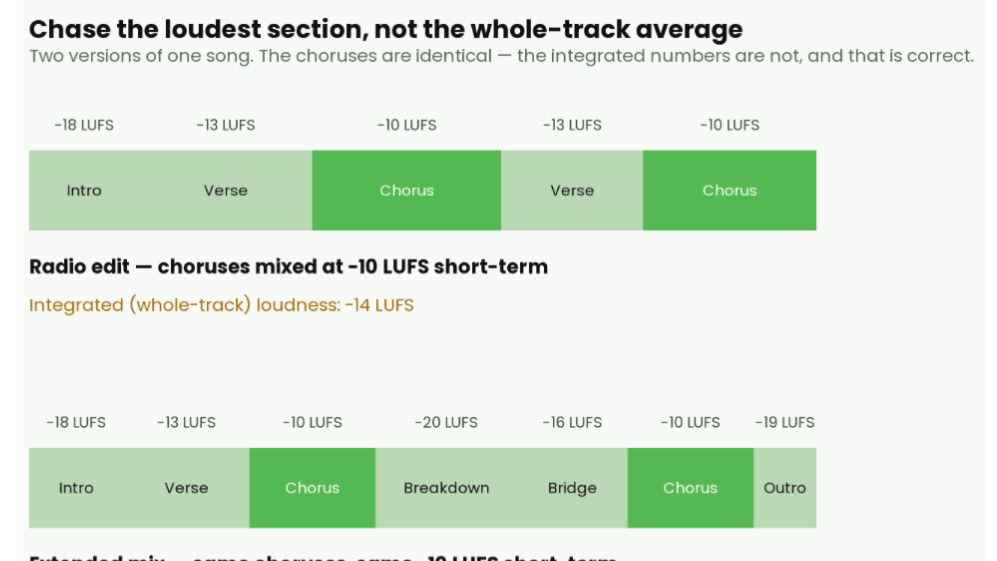
Both versions above have identical choruses at -10 LUFS short-term. The extended mix carries a breakdown and longer intro, so its integrated reading lands at -16 instead of -14. That is not a problem to fix — push it up to -14 and its choruses would now hit harder than the radio edit's. Same song, two different impacts. That is the actual mistake.
So watch the loudest section, not the average. Around -9 to -10 LUFS short-term in your biggest moment puts you where listeners expect modern releases to sit. Genre shifts it: Amapiano and Afrobeats ride sustained low-end energy and sit louder than live highlife or a stripped acoustic gospel take. One target across all of them was never achievable.
What to do: meter your loudest section, keep true peak near -1 dBTP, and trust your ears against two or three references in your own genre.
The numbers worth remembering
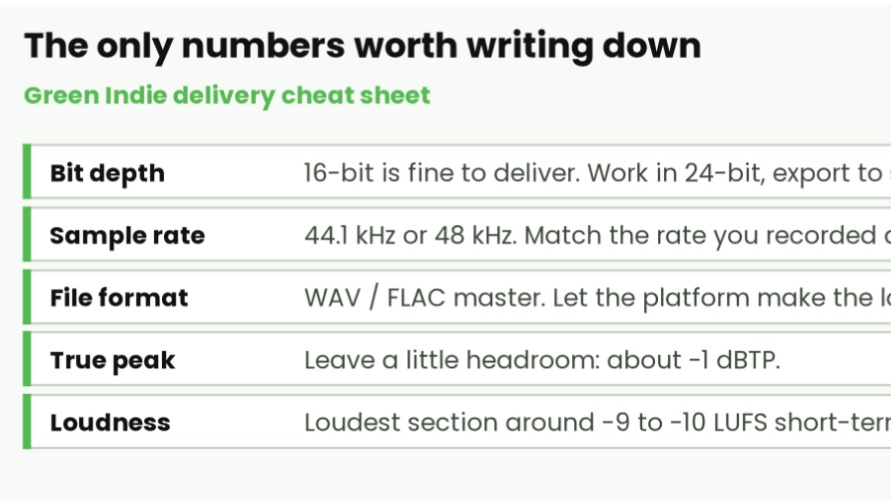
Every one of these myths starts the same way: a real technical detail stretched into a rule it was never meant to be. Bit depth is about noise floor, sample rate is about frequency ceiling, LUFS is about loudness in context. None of them is a quality score, and none is why a song connects. Meet the basic specs, then put your hours back into the writing, the performance, and the fans already waiting.
Ready to release? Green Indie is Africa's first direct-to-fan platform: your music, your fans, your money — no middlemen taking the biggest cut.
Download Green Indie today and start earning directly from your fans.