
Green Indie musings: The Music Is Ours. The Money Should Be Too
Afrobeats won! The money didn't follow. In 2025, Nigerian artists generated 30.3 billion streams on Spotify and shared just over ₦60 billion — roughly ₦2 per stream, before distributors, aggregators and FX take their bite. That is the whole tragedy in one line: a genre that fills the O2 Arena still pays most of its makers in kobo.
This piece is written for the doubter. The one who says "na streaming dey blow artist". Fine. Let's go over this logically, together.
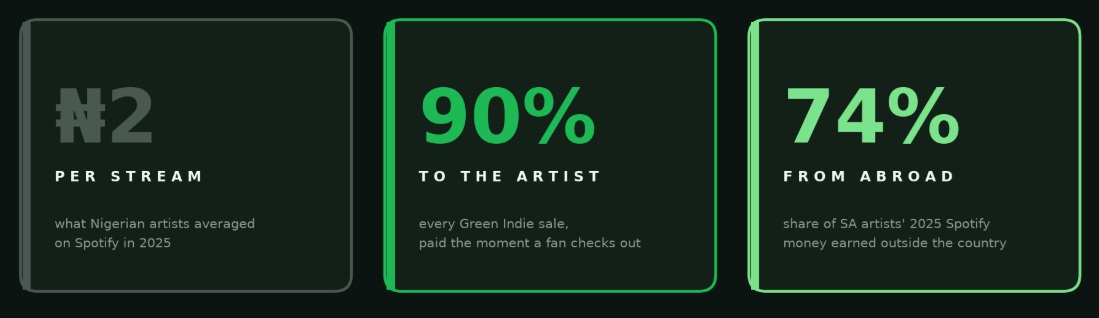
Streaming pays you in reach; direct-to-fan pays you in money. ₦2 per stream in Nigeria versus 90% of a real sale, paid instantly.
The Nigerian stream is structurally the cheapest in the world. Because payouts follow local subscription revenue and Spotify Premium in Nigeria costs ₦1,600/month against $12.99 in the US, a Lagos play is worth a fraction of a Stockholm play — analysts put Nigerian streams near $0.0003 against $0.008–$0.01 in Sweden.
Your real market already lives abroad — and now it can pay you directly. Nearly 74% of the R504 million South African artists earned on Spotify in 2025 came from listeners outside South Africa. Apple Pay and Samsung Pay checkout turns that diaspora into a customer.
Direct-to-fan is proven, not theoretical. Fans have paid artists and independent labels $1.79 billion on Bandcamp, with an average 82% reaching the artist, typically in 24–48 hours. Green Indie brings that model home — and pays better, at 90%, instantly, in the payment rails Nigeria actually uses.
Streaming quietly stopped paying the small artist at all. Since April 2024, a Spotify track earns nothing unless it clears 1,000 streams in twelve months. Ten paying fans on Green Indie beat 999 free plays that pay literally zero.
Analysis
1. The scene every Nigerian artist knows
It's month-end. You open the distributor dashboard with your heart in your mouth because the studio guy is texting. The number loads. ₦11,400. Two hundred thousand streams across eighteen months, four features, one video you shot on borrowed money in Lekki, and a marketing budget that came from your mum's ajo.
Then you scroll Instagram and see the same song playing in a stranger's car in Houston.
That gap — between how loved you are and how broke you are — is not your talent failing. Na the model wan use you. Streaming was built so platforms could sell subscriptions, not so artists could build businesses. You are not the customer in that arrangement. You are not even really the supplier. You are the content that keeps the subscription worth ₦1,600.
2. The maths that nobody wants to do out loud
Let's be honest and use the real, published numbers.
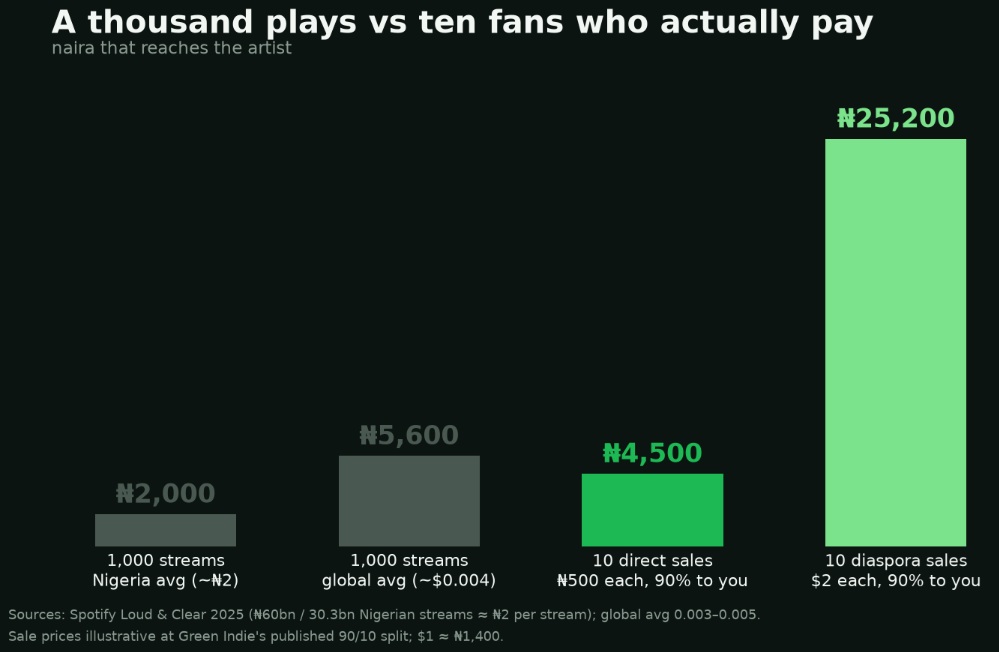
Spotify's own Loud & Clear data for 2025: ₦60 billion across 30.3 billion Nigerian streams — about ₦2 a stream. That is before your distributor's cut, before your producer's split, before FX conversion shaves it again.
So:

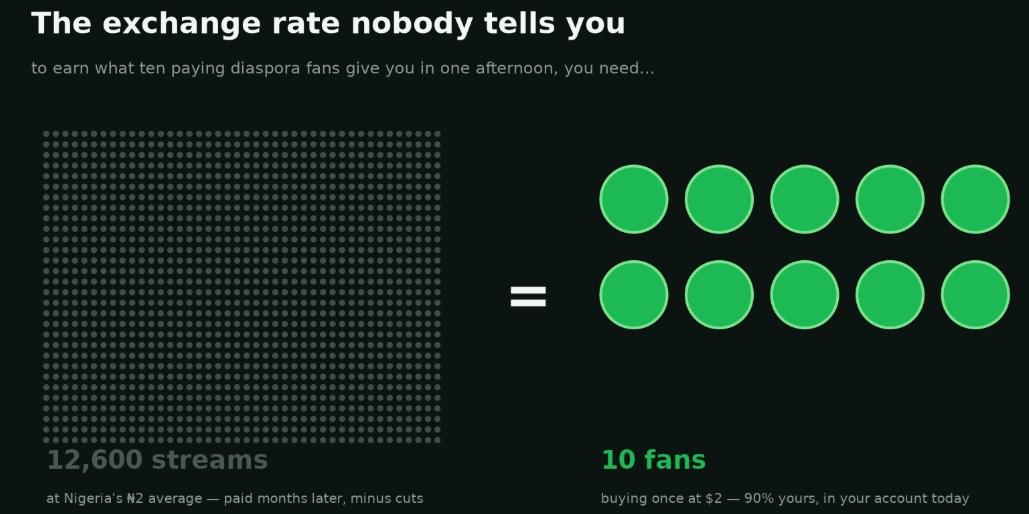
Read that table again. Ten people. Ten. You have more than ten people in your WhatsApp status views who genuinely rate you. The streaming model needed 12,600 plays to match what those ten people can pay you in one afternoon.
Omo, if ten people no go pay ₦500 for your song, the problem no be distribution — na the song. And if they will, why you dey chase 100,000 plays for ₦200k?
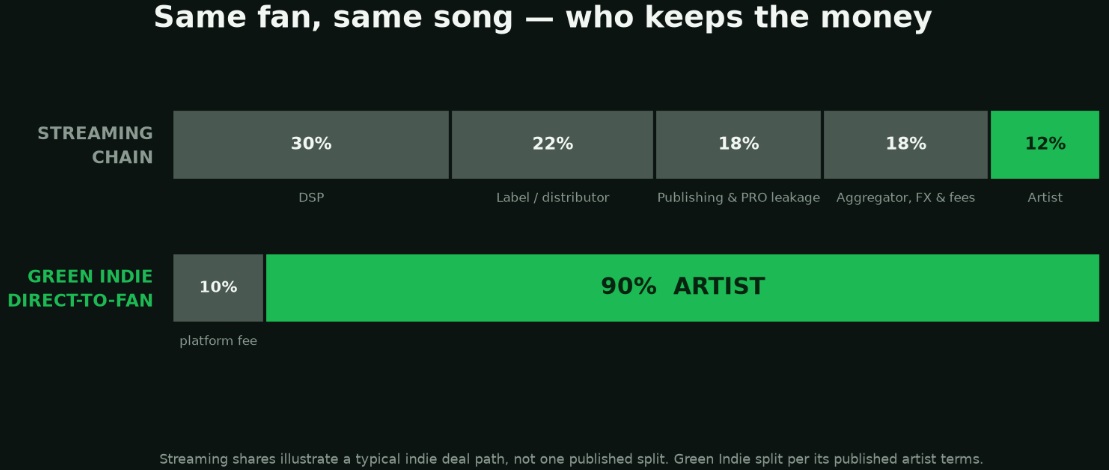
Streaming is a relay race where you run last and everybody ahead of you already collected their medal: the DSP, the label or distributor, the aggregator, the publishing administrator, the collection society, then the FX spread. By the time the baton reaches you, the race done finish. Green Indie collapses the relay into a handshake. Fan pays. You keep 90%. Money lands instantly. Nobody in the middle who needs to be chased, audited, or reminded.
And the ownership question — the one that has ruined more Nigerian careers than bad singles — is settled up front. Green Indie doesn't ask for your masters. Free account, 5GB of storage, upload, price it, sell it, keep it.
3. The diaspora was always the market — now they can actually pay you
Here is the number that should reset your whole strategy. In 2025, nearly 74% of the R504 million South African artists earned on Spotify came from listeners outside South Africa. Nigerian artists live the same reality: the sold-out O2 Arena — Wizkid, then Davido, then Burna Boy, then Asake — is a London building filled with Nigerians and their children who grew up on your sound.
That audience is not poor. A Nigerian nurse in Manchester or an engineer in Maryland will spend £8 on a coffee and croissant without blinking. Dem no dey count ₦1,500 the way we dey count am. And they want to support you personally — that is why they send money home, why they buy the concert ticket, why they wear the merch.
Streaming turns that love into a rounding error. Their play is worth fractions of a cent to you, routed through a revenue pool, delayed by two quarters.
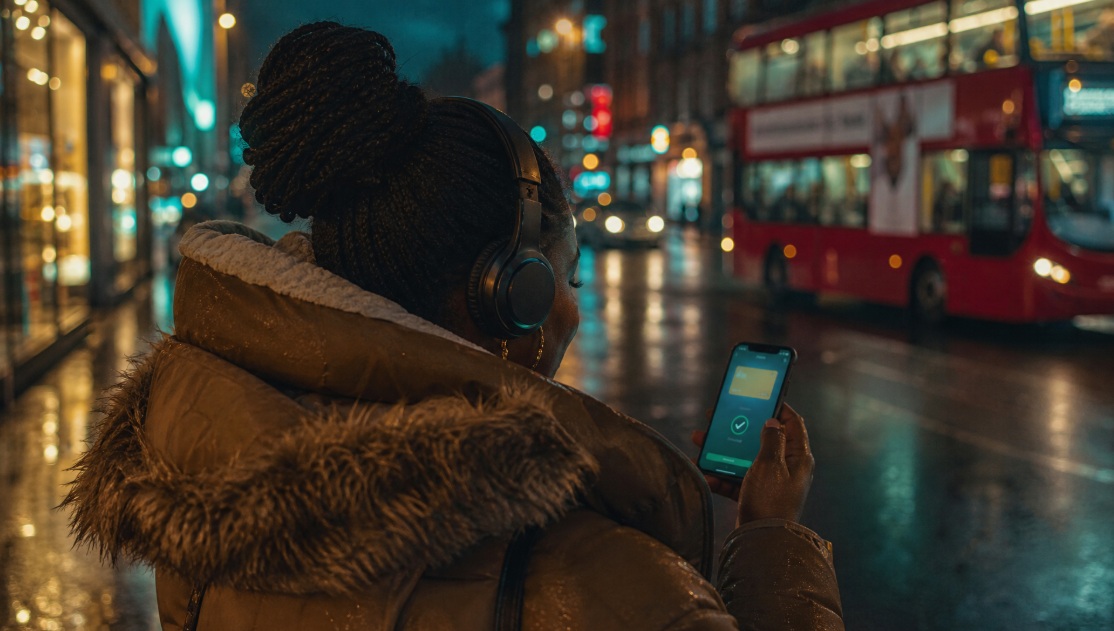
Direct-to-fan turns it into income — and this is exactly the barrier Green Indie has just removed. Diaspora fans can now buy your music in real time with Apple Pay and Samsung Pay. No card entry. No "your card was declined." No 3-D Secure loop that fails on a Nigerian merchant. No asking your cousin in Atlanta to "abeg use your card, I'll refund you." Double-click the side button, Face ID, done — the song unlocks, and your money is already in Lagos. Checkout friction is where fan love goes to die, and one-tap wallets are the single highest-converting way to buy anything on a phone.
Meanwhile, the fans at home buy the way Nigeria actually pays: Opay, PalmPay, bank transfer, or card, through Paystack. One catalogue, two economies, no excuses on either side.
4. Now let's deal with your objections properly
"Nigerians no dey buy music. Everybody wan free." Nigerians spend on what they value and can access easily. Same country buys ₦5,000 concert tickets, ₦15,000 owambe aso-ebi, ₦3,500 hair products from an Instagram vendor with no website, and streams DStv Premium at ₦44,500 a month. What people don't do is fight a broken checkout. The old "no one pays for music here" story was mostly a payments problem wearing a culture costume — and mobile money killed it. Green Indie's 15-second preview handles the rest: fans sample, then unlock. No free rides, but no blind buying either.
"Streaming is exposure. Exposure leads to shows and deals." Sometimes. But exposure you don't own is rented. And note what streaming's own rules now say: under 1,000 streams a year, you get exposure with a ₦0 payout attached. Nobody says abandon DSPs — put your music everywhere. The point is sequencing. Sell to your core first through a pre-release window on Green Indie, earn from the people who love you most while the song is still scarce, then let streaming dilute it to ₦2 a play. Superfans first, algorithm second. That order is the entire difference between a career and a hobby.
"10% is still a cut. Why not just do it myself?" Try it. You'll need hosting, a payment gateway with settlement, mobile-money and wallet integrations, encrypted delivery so the file doesn't leak, previews, QR codes, a marketplace where new fans can find you, and someone to answer the fan whose transfer didn't reflect. 10% for all of that is not a cut — na wages you dey pay. Compare it to the 60–80% you surrender in a typical streaming-plus-label chain, or to Bandcamp's 18% average. Ten percent is the cheapest business partner you will ever have.
"What about royalties from radio, TV, sync?" Green Indie is building that too: automatic ISRC/UPC assignment, filing with international PROs like ASCAP, PRS and SOCAN so diaspora performance royalties find their way home, mechanical collection from DSPs, and a royalty-recovery audit for what you're owed but never received. Add the Nollywood and African-streaming sync pipeline — 2,500+ films and series a year, placement fees quoted at ₦250,000 to ₦7.5M+, and you approve every deal and keep your rights. One placement in a Showmax series can out-earn a year of playlisting. (These are announced as coming-soon capabilities with a waitlist — judge them when they ship, but note the direction: they are all about getting money that already belongs to you.)
I no get enough fans yet. That is precisely the argument for starting now. Streaming pays nothing until you're big; direct-to-fan pays from fan number one. Every song gets a shareable link and its own QR code — put it on your flyer, your merch, your studio wall, your bumper.[^3] Two hundred true fans buying twice a year is a working income in Nigeria. Two hundred fans on Spotify is ₦800.
5. What you are really choosing between
Streaming asks you to be a supplicant: make more, post more, chase the playlist curator, pray for the algorithm, accept a number you cannot audit, months after you needed it.
Direct-to-fan asks you to be an owner: know your fans by name, price your own work, get paid the same day, keep your masters, and build something that doesn't evaporate when a platform changes its policy.
Fela didn't ask for permission. He built the shrine and made people come. Green Indie is the shrine with a checkout button — and a diaspora that can now tap Apple Pay from the front row.
Afrobeats is the sound of the planet right now. The only unfinished business is the money. The music is ours. Make the money follow am home.
What to do this week
Open a free Green Indie artist account and upload one song you already own outright.
Price your next single there before the DSP release date — a genuine pre-release window.
Post the QR code and link to your WhatsApp status, your close friends list, and your loudest fan group. Tell them plainly: buying this directly puts 90% in my hand today.
Message ten diaspora fans individually and tell them Apple Pay and Samsung Pay now work. One tap.
Count the money after seven days. Then compare it to your last royalty statement — and decide with numbers, not vibes.
Direct-to-fan is not a guarantee — it is a better ratio. Ten percent to a platform beats ninety percent to a chain of middlemen, but you still have to make people care.