
.jpg&w=3840&q=75)
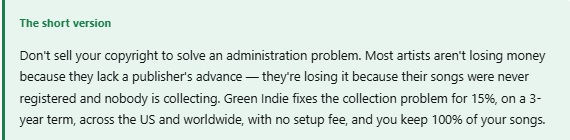
Publishing deals come in four shapes: administration (you keep 100% ownership and pay a percentage of what gets collected), co-publishing (publisher takes 25% and half your copyright), full publishing (publisher takes 50% and all of it), and work-for-hire (you sell the song outright). For the overwhelming majority of independent artists, the correct answer is administration — which is exactly what Green Indie does, at 15% of the publishing royalties we actually recover for you.
A Publishing Deal Is Not a Record Deal
A record deal covers your recordings — the masters. A publishing deal covers your compositions — the melody, the lyrics, the underlying song. They are two separate properties, and they earn two separate sets of money. You can sign one without the other, and plenty of songwriters do.
Your compositions generate four income streams: performance royalties (radio, live, streaming performance), mechanical royalties (streams, downloads, physical), sync fees (film, TV, ads, games), and print royalties. A publisher's job is to register your works everywhere they need to be registered, license them, collect that money, and account to you for it.
The only real question in any publishing deal is what you hand over in exchange for that work. The four standard structures answer that question very differently.
The Four Types, Side by Side
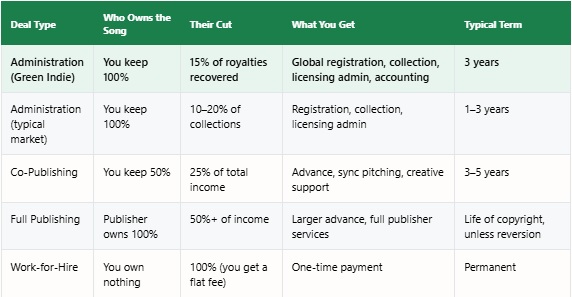
Read that table from top to bottom. Everything below the first two rows costs you ownership. Nothing below the first two rows gives you a service you cannot buy outright for a percentage.
Administration Deals: The Default Answer
An administration deal is a service agreement, not a sale. The administrator handles the paperwork and the chasing; you pay a percentage of what comes back. You keep your copyright, your writer's share, your publisher's share, and your name on the song forever.
A working administrator registers your compositions with performing rights organisations, mechanical societies and international collecting bodies, handles licensing requests, chases unmatched and unclaimed royalties, and gives you one consolidated statement instead of a dozen partial ones.
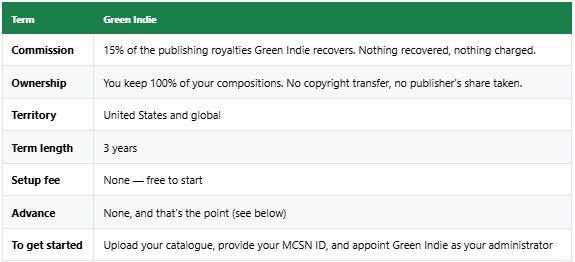
Green Indie's terms
The math
Your songs generate $10,000 in publishing income. At 15%, Green Indie retains $1,500 and you keep $8,500 — and you still own 100% of every song. Run the same $10,000 through a co-publishing deal and you keep $7,500 while giving away half your copyright permanently. Run it through a full publishing deal and you keep $5,000 and own nothing.
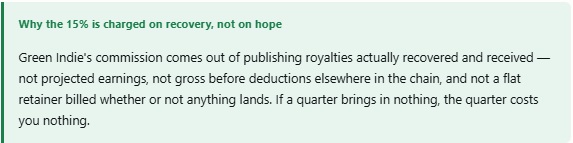
Now run the real comparison, which is not 15% versus 25%. It's 15% of collected money versus 100% of money nobody ever collected. Unregistered compositions do not pay out; they sit in unmatched pools until they are written off. The fee only applies to royalties that reach you.
Best for
Independent artists and songwriters who own their catalogue and want it collected properly worldwide; artists releasing consistently who have never been registered beyond their local society; anyone who has been offered a co-pub or full deal and cannot yet justify handing over half a copyright.
What to check in any admin agreement
The percentage. 10–20% is the market. Green Indie is 15%.
What the percentage applies to. Collections received, or something vaguer?
The term. 1–3 years is normal. Green Indie is 3 years.
Exclusivity and territory. Who can collect where, and for what.
The retention period. How long the administrator keeps commissioning pipeline royalties after the term ends — 6–12 months is standard.
Ownership language. An admin deal should never assign copyright. If you see an assignment of any interest in the composition, it is not an admin deal.
Co-Publishing Deals
Co-publishing is the standard structure for signed songwriters, and the point where you begin selling ownership.
Publishing income is traditionally split into two halves: the writer's share (50%) and the publisher's share (50%). In a co-pub deal you keep all of the writer's share and split the publisher's share down the middle. Net result: you keep 75%, the publisher keeps 25% — and, critically, the publisher now owns half of the copyright itself, not just a slice of the income.
In exchange you typically get a recoupable advance, active sync pitching, co-writing introductions, creative development and administration.
The math
Your songs generate $100,000. You receive $75,000, the publisher $25,000. But if you took a $50,000 advance, the first $50,000 of your $75,000 goes to repaying it. You see $25,000 in actual cash — and you gave up half of your copyright to get it.
Best for
Writers who genuinely need capital now, and who are getting real pitching and real rooms in return. If the advance isn't life-changing and the pitching isn't specific, you are paying ownership for administration you could have bought for 15%.
What to check
The actual split. “Standard co-pub” means different things to different publishers. Get the number in writing.
Advance and recoupment. How much, against which share, and what is recoupable.
Delivery requirements. How many songs per year, and what counts as delivered.
Term and options. Options are the publisher's choice, not yours.
Reversion. When, if ever, does your half come back?
Full Publishing Deals
A full publishing deal transfers 100% of the publishing to the publisher. You keep your writer's share and nothing else. The publisher owns the copyright, takes the entire publisher's share and controls every licensing decision — including the ones you would have said no to.
The math
Your songs generate $100,000. You receive $50,000. The publisher receives $50,000 and owns the catalogue. Any advance is recouped out of your $50,000.
The only defensible reason to sign one is an advance so large it cannot be matched anywhere else, negotiated by a lawyer, with reversion language you have read twice.
Work-for-Hire
Work-for-hire is not a publishing deal at all. It is a sale. You write, you are paid once, the client owns the composition outright, and you have no ongoing royalty rights of any kind.
It is common and legitimate in jingle writing, some production music libraries, corporate custom songs and parts of film and TV scoring. It becomes a mistake when the fee is small and the song has a life ahead of it.
The math
You are paid $5,000. Over the next decade the song earns $1,000,000 in sync. You receive none of it, and you cannot claim it back.
Refuse it when the song has obvious ongoing value, when the fee is below market for the use, or when you are being pushed into it because nobody wants to do the administration.
How Advances Actually Work
Recoupment. An advance is a loan against your own future royalties. Until your share equals the advance, you receive no further payments.
Cross-collateralization. Watch for it. It lumps all your songs and agreements together for recoupment, so a hit cannot pay you while anything else is still unrecouped.
Unrecouped advances. You usually don't owe the cash back — but you see nothing until it clears, and your next deal will be priced off that track record.
The uncomfortable arithmetic: an advance is your money, paid early, in exchange for a permanent piece of your copyright. Administration costs you a percentage and costs you no ownership at all. If you don't need the cash today, the advance is the most expensive money in the music business.
##Evaluating an Offer
Questions to ask
- What is the actual split, in numbers, in the contract?
- What is the advance, and is it genuinely worth the ownership it costs?
- How long is the term, and how many future songs does it capture?
- What are the delivery requirements, and what happens if you miss them?
- Is there a reversion clause, and what triggers it?
- What pitching will actually happen? “We'll pitch your songs” is noise. “We pitch weekly to these supervisors” is a commitment.
- Who else is on the roster, and where would you sit on it?
Red flags
- No reversion clause on a full publishing deal
- Copyright assignment language buried inside something sold to you as “admin”
- A commission rate that references a pricing schedule you have never been shown
- Vague delivery requirements that can be read against you later
- Cross-collateralization across multiple agreements
- Advances well below market for your level
- Pressure to sign before a lawyer reads it
- A publisher who cannot name a single placement they have secured
##When to Sign, When to Wait
Sign a co-pub or full deal if the advance meaningfully changes your ability to make music full time, the publisher has a real track record in your genre, the reversion language is reasonable, a lawyer has read it, and you can state precisely what you are giving up.
Start with administration if your catalogue isn't registered properly, your royalties are unpredictable or unexplained, you don't need an advance today, or you simply aren't ready to sell half a copyright to fix a paperwork problem. That is most artists, most of the time.
Start With Green Indie
Green Indie is an administrative publisher. That is the entire scope of the relationship: we register, license, collect and account, and we retain 15% of the publishing royalties we recover for you. We do not take your copyright, we do not take a publisher's share, and we do not need to own your songs to collect on them.
Three steps to get set up
-
Upload your catalogue. Every composition you have written or co-written, with splits and metadata.
-
Provide your MCSN ID. So your works can be matched and your local rights reconciled with global collection.
-
Appoint Green Indie as your administrator. 3-year term, United States and global territory, no setup fee, 15% of what we recover.

This article is general information about publishing deal structures, not legal advice. Commercial terms are those in force at the date shown above; the governing terms are the ones in your signed agreement and applicable pricing schedule.